
One hundred metres is the figure that matters most when driving in fog in Great Britain. The Highway Code describes visibility as seriously reduced generally when a driver cannot see for more than 100 metres (328 feet), and at that point headlights become a legal requirement. This guide sets out what the Highway Code says about fog, how the Met Office defines it, and how the eyesight standard for driving relates to seeing in poor visibility. The GOV.UK Highway Code states that it applies to England, Scotland and Wales.
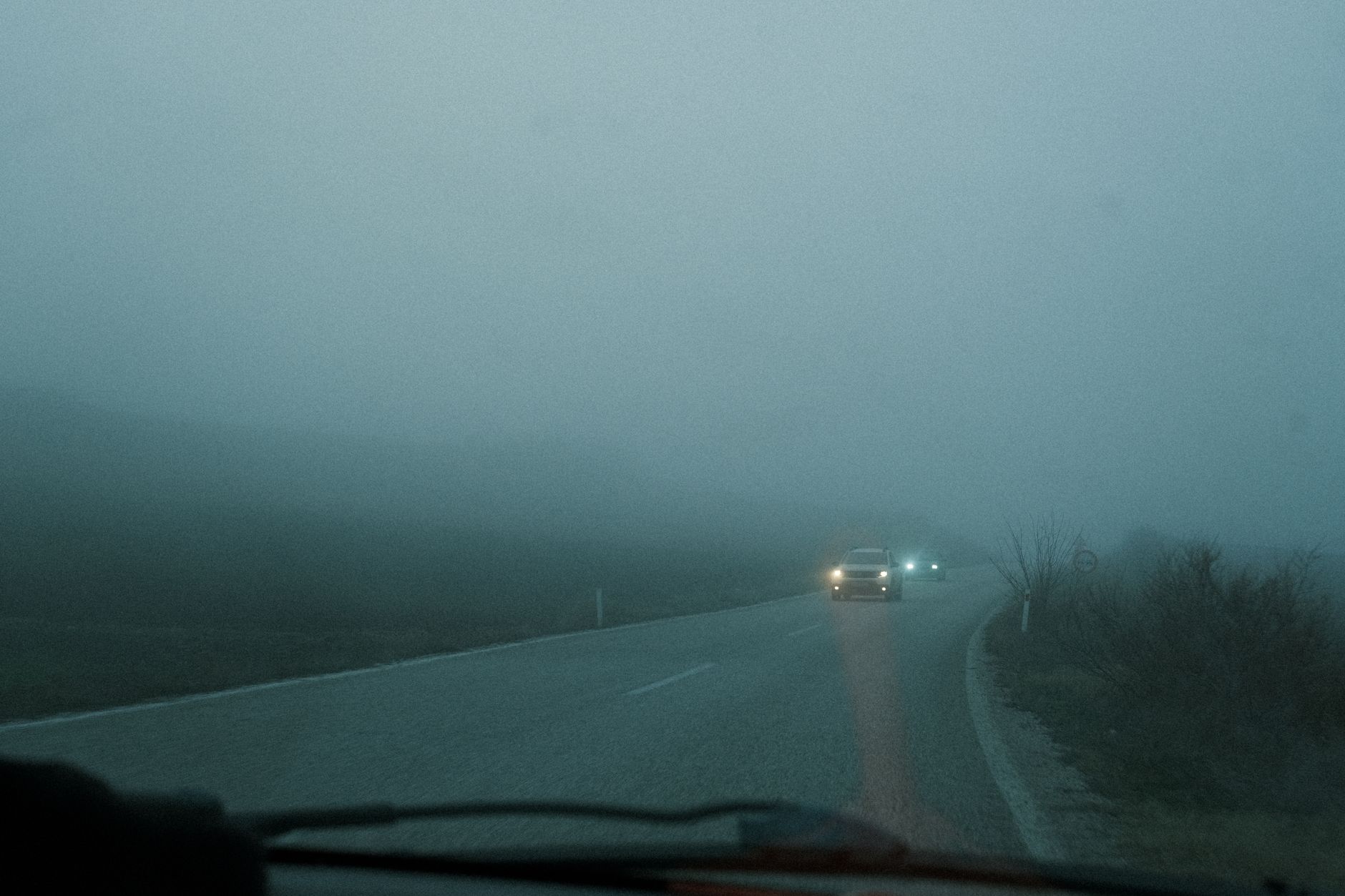
100 metres: when the law on lights changes
Rule 226 of the Highway Code says drivers MUST use headlights when visibility is seriously reduced, generally when they cannot see for more than 100 metres. It adds that front or rear fog lights may also be used, but MUST be switched off when visibility improves. The legal basis given for both points is regulations 25 and 27 of the Road Vehicles Lighting Regulations (RVLR).
Rule 113 repeats the headlight duty alongside the night-time rules, and Rule 114 sets out the other side of it: drivers MUST NOT use front or rear fog lights unless visibility is seriously reduced, and MUST switch them off when visibility improves to avoid dazzling other road users. Rule 236 gives the reason in plain terms: fog lights dazzle other road users and can obscure brake lights.
In the Highway Code, rules worded with MUST or MUST NOT are legal requirements, which is why both the duty to use headlights and the duty to switch fog lights off again are written that way and carry a reference to the regulations.
1,000, 180 and 100 metres: how the Met Office describes fog
The Met Office defines fog as cloud at ground level that reduces visibility to less than 1,000 metres. It explains that this international definition is used particularly for aviation, while in forecasts for the public the word fog generally refers to visibility of less than 180 metres. When visibility falls below 100 metres, the Met Office calls it dense fog and notes that it can cause severe travel disruption.
The Met Office describes several types of fog, including:
- Radiation fog usually occurs in winter, with clear skies and calm conditions, and usually clears soon after sunrise as the ground warms.
- Valley fog forms where cold, dense air settles in the lower parts of a valley and can last for several days in calm winter conditions.
- Freezing fog forms at sub-zero temperatures and leaves a white deposit of ice crystals, called rime, on surfaces it freezes onto.
The Met Office’s 100-metre threshold for dense fog is the same distance the Highway Code gives as the general marker for seriously reduced visibility.
What Rules 234 and 235 ask of a driver in fog
Rule 234 says that before entering fog, a driver should check the mirrors and then slow down. Where a “Fog” sign is shown but the road looks clear, it warns that a bank of fog or drifting patchy fog may lie ahead, and that a driver can suddenly find themselves in thick fog even if it seems to be clearing.
Rule 235 lists what a driver should do once in fog:
- Use lights as required under Rule 226.
- Keep a safe distance behind the vehicle in front, because rear lights can give a false sense of security.
- Be able to pull up well within the distance that can be seen clearly, which the rule says is particularly important on motorways and dual carriageways.
- Use windscreen wipers and demisters.
- Beware of other drivers not using headlights.
- Not accelerate to get away from a vehicle that is too close behind.
- Check mirrors before slowing down, then brake so the brake lights warn drivers behind.
- At a junction with limited visibility, stop in the correct position and listen for traffic, then emerge positively once sure it is safe.
Rule 126 sets the general principle behind point three: drive at a speed that allows stopping well within the distance that can be seen to be clear. It also says the gap to the vehicle in front should be at least two seconds on high-speed roads and in tunnels where visibility is reduced.
Fog, frost and a clear windscreen
Winter fog often comes with frost. Rule 229 says that before driving in icy or snowy weather a driver MUST be able to see, so all snow and ice must be cleared from all windows, and lights MUST be clean and number plates clearly visible and legible. It adds that mirrors should be clear and windows demisted thoroughly. Rule 228 advises checking the local forecast for warnings of icy or snowy weather and not driving in those conditions unless the journey is essential.
Where eyesight comes in
GOV.UK says a driver must be able to read a number plate from 20 metres away, about the length of five parked cars, with glasses or contact lenses if they are used for driving. A visual acuity of at least decimal 0.5 (6/12) on the Snellen scale and an adequate field of vision are also required, and GOV.UK says anyone who needs glasses or contact lenses to meet the standard must wear them every time they drive.
None of these figures describes fog. A driver who meets the standard on a clear day still has to apply Rule 235 and pull up within the distance that can be seen clearly. The Highway Code’s separate advice on dazzle and tinted lenses is set out in glasses, tinted lenses and dazzle, and anyone with an eye condition can check the reporting rules in eye conditions and driving.
The bottom line
In Great Britain the Highway Code ties the lighting rules to visibility of generally less than 100 metres: headlights are then required, fog lights are allowed, and fog lights must go off again when visibility improves. The Met Office calls that level of visibility dense fog. Meeting the 20-metre number plate standard on a clear day does not change what fog demands, which is slowing down, keeping well back and stopping within the distance that can be seen clearly.
Sources
- The Highway Code: Driving in adverse weather conditions (226 to 237), GOV.UK, updated 22 October 2025, read 18 November 2026 (gov.uk)
- The Highway Code: General rules, techniques and advice for all drivers and riders (103 to 158), GOV.UK, read 18 November 2026 (gov.uk)
- The Highway Code: Introduction, GOV.UK, read 18 November 2026 (gov.uk)
- What is fog?, Met Office, read 18 November 2026 (metoffice.gov.uk)
- Driving eyesight rules, GOV.UK, read 18 November 2026 (gov.uk)
Leave a Reply