
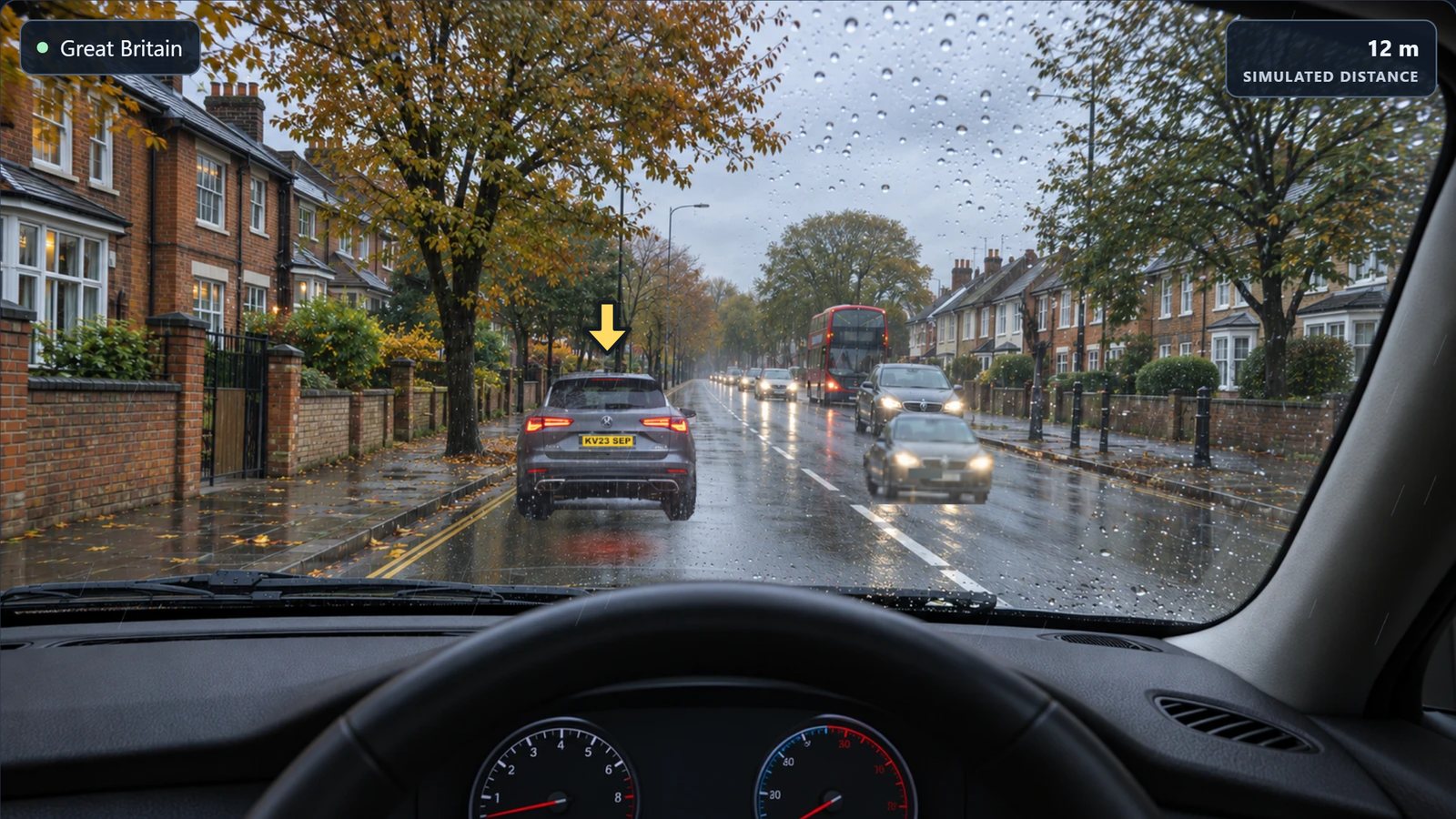
20 metres is about 65.6 feet or 21.9 yards, which GOV.UK describes as roughly the length of 5 parked cars. It matters to drivers because in the UK you must be able to read a car number plate from 20 metres away in good daylight, with glasses or contact lenses if you need them.
20 metres in other units
| Distance | Feet | Yards | Rough everyday comparison |
|---|---|---|---|
| 20 metres (current-style number plate) | 65.6 ft | 21.9 yd | About the length of 5 parked cars (GOV.UK) |
| 20.5 metres (old-style number plate) | 67.3 ft | 22.4 yd | Half a metre further |
| 10 metres | 32.8 ft | 10.9 yd | Half the test distance |
Conversions: 1 metre = 3.281 feet = 1.094 yards, rounded to one decimal place.
Why 20 metres matters for drivers
Highway Code Rule 92 says you must be able to read a vehicle number plate, in good daylight, from a distance of 20 metres, or 20.5 metres where the old-style number plate is used. If you need glasses or contact lenses to do this, you must wear them at all times while driving. The plate check is one of three parts of the standard; the other two, visual acuity and field of vision, are covered in eye tests for drivers in the UK.
The examiner checks this at the start of the practical driving test, and Rule 92 adds that the police have the power to require a driver to take an eyesight test. For the background to the rule and the two distances, see the 20-metre number plate rule.
How to measure 20 metres accurately
“About 5 parked cars” is a handy guide, but car lengths vary, so measure if you want to check your eyesight properly.
- Use a tape measure or measuring wheel. The most accurate way. A 10-metre tape laid out twice works.
- Use a phone measuring app with care. Augmented-reality apps can drift over long distances; check against a tape if you can.
- Calibrate your own pace. Measure 10 metres once with a tape, count how many normal steps it takes, then double it. Everyone’s stride is different, so do not rely on a fixed number of steps.
- Use a known distance. Some sports pitches and running tracks have marked distances; check what the markings mean before relying on them.
Doing the number plate check yourself
- Choose a quiet place in good daylight, away from traffic.
- Measure 20 metres from a parked car’s number plate.
- Wear your driving glasses or contact lenses if you use them.
- Read the plate aloud and have someone confirm it, or take a photo to check afterwards.
- If you cannot read it, do not drive until you have seen an optician.
Indoors, our interactive step-back check scales a plate to a shorter distance on your screen. It is practice only, not a sight test; see what a screen check can and cannot tell you. Learners can also try the eyesight practice on our sister site, Get Driving Test Ready, before test day.
Frequently asked questions
How far is 20 meters in car lengths?
GOV.UK says about the length of 5 parked cars. Actual car lengths vary, so measure if you are checking your eyesight.
How far is 20 metres in feet?
About 65.6 feet.
How far is the eyesight test for driving?
The UK driving test eyesight distance is 20 metres for a current-style number plate, or 20.5 metres for an old-style plate. You read the plate at the start of the practical test, in good daylight, with glasses or contact lenses if you need them.
Why is it 20.5 metres for some number plates?
The Highway Code gives 20.5 metres where an old-style number plate is used. Our explainer sets out why the regulations have two distances: see the 20-metre rule explained.
What if I can only read the plate at a shorter distance?
You do not meet the standard for driving. Book an eye test and do not drive until an optician confirms you meet it, with glasses or lenses if needed.
The bottom line
20 metres is about 65.6 feet, or roughly the length of 5 parked cars as GOV.UK puts it, and 20.5 metres applies to old-style plates under Highway Code Rule 92. Car lengths vary, so use a tape measure or a measuring wheel if you want to check your eyesight properly, and do the check in good daylight with your driving glasses or lenses on.
Sources
- Driving eyesight rules (gov.uk)
- The Highway Code, Rule 92 (gov.uk)
Leave a Reply