Searching for a driving eyesight test online usually turns up screen checks that show a number plate or a row of letters and ask what can be read. They can be useful practice, but none of them is the legal test or a substitute for an optician. This guide sets out what GOV.UK and the Highway Code require and which parts a screen can imitate.
The short answer: practice, not proof
An online check cannot confirm that a driver meets the legal eyesight standard, it is not the number-plate check on a real car, and it is not a sight test. The UK number plate practice check on this site carries the same warning on screen: it is practice only and cannot tell a user whether they meet the legal standard, which also covers visual acuity and field of vision.
What the eyesight rules actually ask of a car driver
GOV.UK’s driving eyesight rules set out three parts to the standard:
- Reading a number plate from 20 metres away, which GOV.UK describes as about the length of 5 parked cars. Glasses or contact lenses can be worn if they are used for driving.
- A visual acuity of at least decimal 0.5 (6/12) measured on the Snellen scale, with glasses or contact lenses if necessary, using both eyes together or, where someone has sight in one eye only, in that eye.
- An adequate field of vision. GOV.UK says an optician can explain this and do a test.
Rule 92 of the Highway Code adds the conditions of the plate reading: it is done in good daylight, from 20 metres, or 20.5 metres where an old-style number plate is used. Anyone who needs glasses or contact lenses to do this must wear them at all times while driving, and the police have the power to require a driver to take an eyesight test. GOV.UK warns that a driver could be prosecuted for driving without meeting the standards. Lorry and bus licences carry higher standards.
Common beliefs about online eyesight checks, tested against the rules
“If I can read the plate on screen, I would pass on the day”
That does not follow. Rule 92 describes reading a real vehicle number plate in good daylight at a set distance. A screen shows a drawing of a plate indoors. Even this site’s scaled check, which asks users to size the screen against a bank card, remains a picture on a screen, and the same page tells users to check a real number plate from 20 metres before a test.
“A screen check measures my visual acuity”
GOV.UK states the acuity part of the standard as decimal 0.5 (6/12) on the Snellen scale, which is separate from the plate reading. The outdoor guide on this site says plainly that a home check does not measure the separate visual acuity and field-of-vision requirements. For what figures such as 6/12 mean, see reading your eyesight numbers.
“Side vision can be checked online”
GOV.UK points drivers to an optician for the field of vision. Where a driver reports a condition affecting their vision, DVLA may refer them for an eyesight test with its contracted optician, and the driver does not pay for it. Results from another optician can be submitted if the test includes an Esterman visual test, although DVLA does not guarantee to accept them and the driver pays. Neither route involves a screen check at home. More detail is in the field-of-vision guide.
“An online result could be shown to the examiner”
GOV.UK’s car test page says the eyesight check involves reading a number plate from 20 metres for a new-style plate, or 20.5 metres for an old-style plate, and that failing it means failing the driving test, which then ends. The eyesight rules page adds that DVLA will be told and the licence will be revoked, and that on reapplying, DVLA will ask for an eyesight test with DVSA at a driving test centre. Neither page mentions any role for an online result.
“If my eyes feel fine, there is no need for an optician”
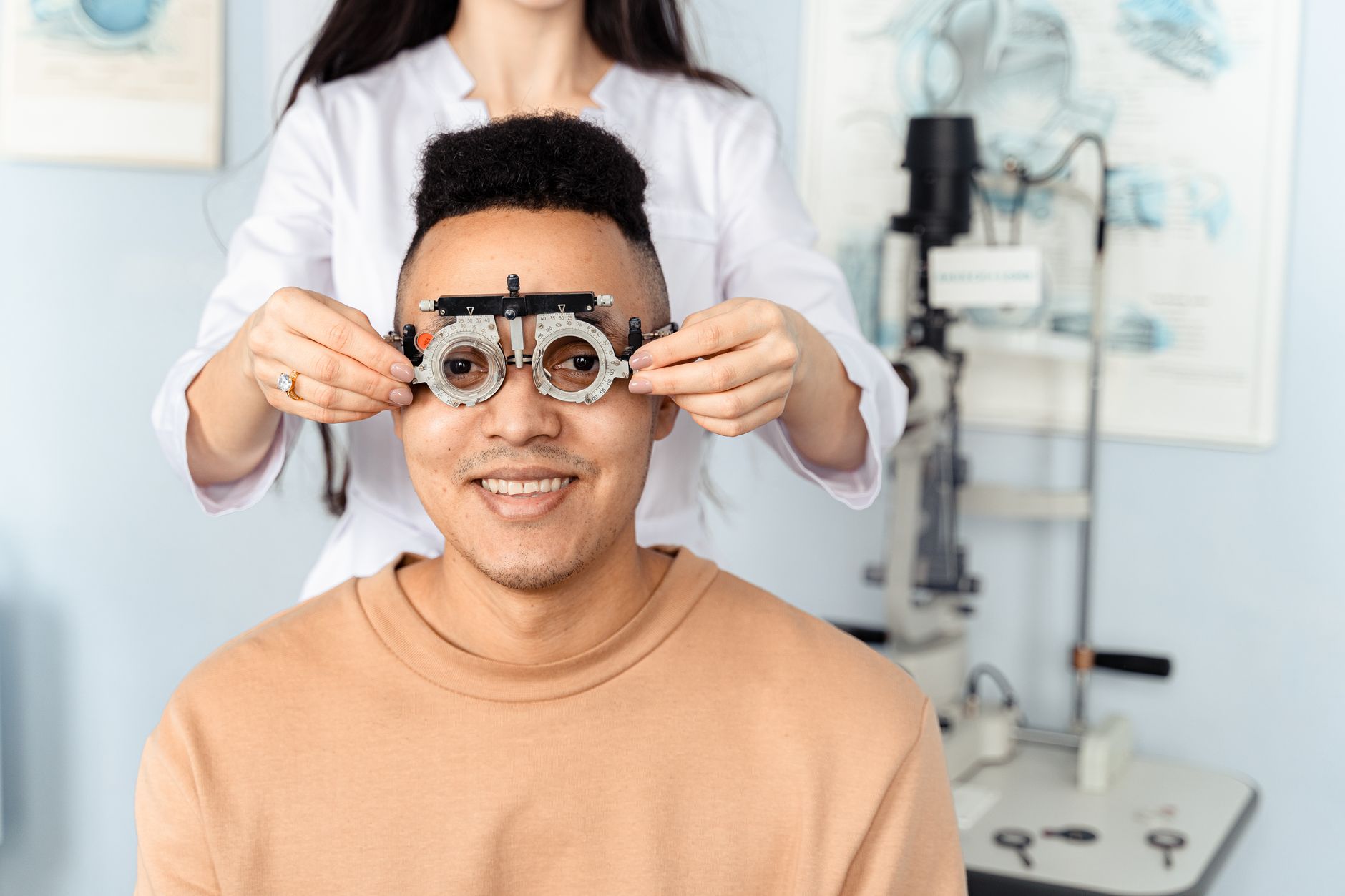
The NHS notes that eyes rarely hurt when something is wrong with them, and it recommends an eye test every 2 years, or more often if an optometrist or ophthalmic practitioner advises it. During a sight test, an optometrist examines the internal and external structure of the eyes to detect conditions such as glaucoma, macular degeneration and cataracts. An NHS sight test is free for people in an eligible group, such as those aged 60 or over or diagnosed with diabetes or glaucoma, when the test is considered clinically necessary.
Where a screen check still earns its place
- Rehearsal. It gives a feel for reading a plate before trying the real thing outdoors.
- A prompt to act. This site’s practice page tells anyone unsure about their eyesight to see an optician, and anyone struggling to arrange a professional sight test before their driving test.
- A bridge to the outdoor check. The site’s guide covers measuring 20 metres from a parked car’s modern plate with a tape measure rather than by footsteps, reading it in good daylight with driving glasses or lenses, and having someone check the answer.
When practice should give way to action
If a real plate cannot be read at the Rule 92 distance in good daylight, the standard is not being met. Separately, GOV.UK says drivers must tell DVLA about any eyesight problem that affects both eyes, or the remaining eye for someone with one eye. That does not include being short or long sighted or colour blind. The steps after a change in vision are covered in eyesight getting worse? what drivers should do next and reporting vision changes to your licensing authority.
The bottom line
A driving eyesight test online is a rehearsal. The standard on GOV.UK combines reading a real number plate at 20 metres, a visual acuity of at least 6/12 and an adequate field of vision, and only the first resembles anything a screen can show. Practise online, do the real plate check outdoors, and book a sight test with an optometrist for the rest.
Sources
- Driving eyesight rules, GOV.UK, page undated, read 16 November 2026 (gov.uk)
- The Highway Code: Rules for drivers and motorcyclists (89 to 102), Rule 92, GOV.UK, read 16 November 2026 (gov.uk)
- Driving test: cars, What happens during the test, GOV.UK, read 16 November 2026 (gov.uk)
- Visiting an optician, NHS, read 16 November 2026 (nhs.uk)
- Free NHS eye tests and optical vouchers, NHS, read 16 November 2026 (nhs.uk)
Leave a Reply