
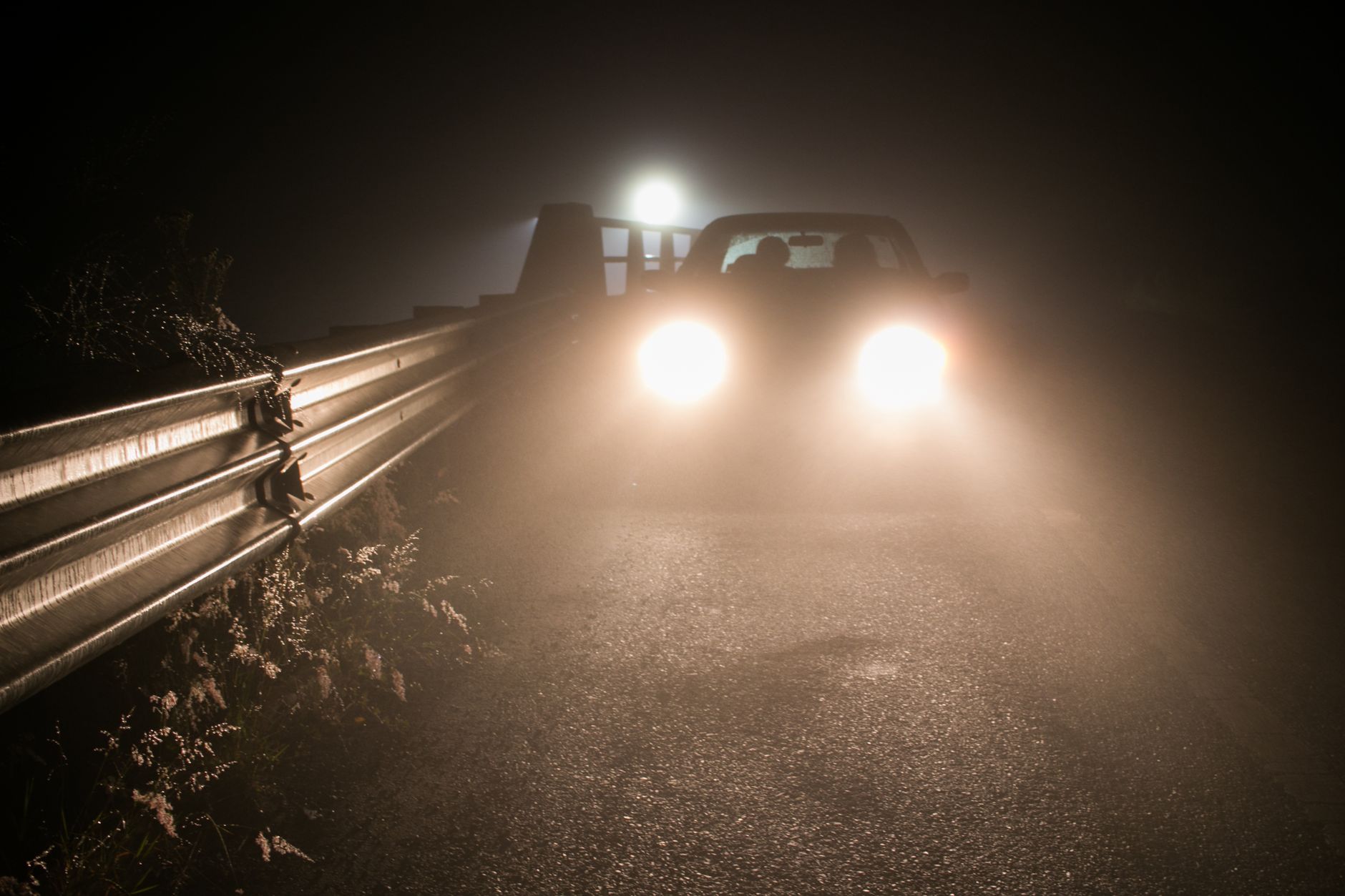
Photo: Ricardo Martínez González, Pexels
Eye conditions affect driving in different ways. Some blur everything, some quietly remove parts of the view, and some cause trouble mainly after dark. Licensing rules follow the same logic, which is why one condition must be reported straight away while another never needs mentioning.
This is general information, not medical advice. If you have, or think you might have, any of these conditions, speak to an optometrist or your doctor about whether you are safe and legal to drive.
The three things DVLA checks for car drivers
Gov.uk sets three standards, measured with glasses or contact lenses if you wear them to drive:
- Number plate: you must read one from 20 metres, about five parked car lengths. Fail this at the start of your practical test and the test does not continue.
- Visual acuity: at least decimal 0.5 (6/12) on the Snellen scale, with both eyes together, or your seeing eye if you only have sight in one.
- Visual field: DVLA guidance asks for at least 120 degrees horizontally, extending 50 degrees left and right, with no significant defect in the central 20 degrees.
You must tell DVLA if a condition affects both eyes (or your only seeing eye), if a GP, optician or eye specialist says you should not drive, or if you do not meet the standards. Some conditions must be reported by name: blepharospasm, diabetic retinopathy treated with laser, diplopia, glaucoma, nyctalopia and retinitis pigmentosa. Not reporting can bring a fine of up to £1,000.
Conditions that blur, dazzle or dim the view
Cataracts
The NHS describes clouding of the eye’s lens, causing blurry vision, glare sensitivity, faded colours and halos around headlights. Cataracts are not on DVLA’s named list, but the general rules apply. DVLA warns that glare can stop someone passing the number plate test even when acuity seems adequate. Surgery replaces the cloudy lens with an artificial one.
Keratoconus
The American Academy of Ophthalmology explains that the cornea thins and bulges into a cone, causing blurred, distorted vision and sensitivity to glare. It is not named on the car list, so the general triggers decide whether you report it.
Night vision problems
Night blindness (nyctalopia) is a named condition. DVLA says you must stop driving and notify them; a licence may be granted after individual consideration if you meet the acuity and field standards.
Conditions that take pieces out of the picture
Glaucoma
The US National Eye Institute says glaucoma usually starts in side vision and progresses slowly, so many people do not notice. Treatment can stop further damage but will not undo it. On the road, hazards emerging from the side can be missed. Glaucoma is a named condition.
Diabetic retinopathy
High blood sugar damages blood vessels in the retina. The NHS says early stages often have no symptoms; later come blurred vision, floaters and difficulty seeing in low light. If yours has been laser-treated, tell DVLA, which may refer you for a free eyesight test.
Age-related macular degeneration
AMD affects central vision. The NHS lists a blurred or distorted central area and wavy straight lines among its symptoms. It does not cause total blindness, but number plates and signs become harder to read. AMD is not named on the car list, but the both-eyes rule and the standards still apply.
Field loss after a stroke
After a stroke or TIA, gov.uk says stop driving for at least one month and restart only when your doctor says it is safe. If visual field loss or double vision remains after a month, tell DVLA.
When two eyes stop working as a pair
Sight in one eye only
You can drive a car with monocular vision. Gov.uk says you need not tell DVLA if you still meet the standards, though DVLA guidance says you should drive only after clinical advice that you have adapted.
Double vision
The NHS defines double vision as seeing two images of one object; sudden onset needs urgent help. DVLA says stop driving and notify them. Driving may resume once it is controlled, for example with glasses or a patch.
Colour vision: usually not an issue
Colour vision deficiency means finding some colours hard to tell apart. Gov.uk says you do not need to tell DVLA if you are colour blind.
UK car drivers at a glance
| Condition | Main effect | Tell DVLA? |
|---|---|---|
| Cataracts | Blur, glare, halos | If both eyes or below standard |
| Keratoconus | Blur, distortion | If both eyes or below standard |
| Night blindness | Poor low-light vision | Yes |
| Glaucoma | Side vision loss | Yes |
| Diabetic retinopathy | Blur, floaters | Yes, if laser-treated |
| AMD | Central blur | If both eyes or below standard |
| Field loss after stroke | Missing areas | Yes, if present after one month |
| Monocular vision | One seeing eye | Not if standards met |
| Double vision | Two images | Yes |
| Colour vision deficiency | Colour confusion | No |
How other countries handle it
Ireland: The RSA’s Group 1 standard, on the D502 eyesight report form, is binocular acuity of at least 6/12 and a horizontal field of at least 120 degrees. A first learner permit needs a D502 from a registered optometrist or doctor. After losing sight in one eye, there is an adaptation period of at least six months without driving. See our Ireland guide.
United States: Each state sets its own rules. The American Academy of Ophthalmology notes states generally require 20/40 or better in at least one eye for unrestricted driving. More on our US page.
Canada: Licensing is provincial. British Columbia, for example, uses the Canadian Council of Motor Transport Administrators medical standards, whose vision chapter covers acuity, fields, double vision and colour vision.
Australia: Assessing Fitness to Drive, from Austroads and the National Transport Commission, is the national standard used by licensing authorities in every state and territory. Austroads says there is no colour vision standard for drivers. See our Australia page.
Practising the plate check
Our number plate practice and vision games help you get familiar with the 20-metre check. They are not a medical test and cannot detect any condition here; regular eye tests can.
The bottom line
Most eye conditions do not automatically end your driving, but several must be reported, and everyone must meet the plate, acuity and field standards. If your vision changes, get checked before you next drive.
Sources
- Driving eyesight rules (gov.uk)
- Eye conditions and driving (gov.uk)
- Visual disorders: assessing fitness to drive (gov.uk)
- Visual field defects and driving (gov.uk)
- Diabetic retinopathy and driving (gov.uk)
- Monocular vision and driving (gov.uk)
- Stroke and driving (gov.uk)
- Cataracts (nhs.uk)
- Age-related macular degeneration (nhs.uk)
- Diabetic retinopathy (nhs.uk)
- Double vision (nhs.uk)
- Colour vision deficiency (nhs.uk)
- Glaucoma (nei.nih.gov)
- What is keratoconus? (aao.org)
- How much vision loss is too much when it comes to driving? (aao.org)
- Medical fitness to drive in Ireland (rsa.ie)
- Driving Licence Eyesight Report Form (rsa.ie)
- CCMTA Medical Standards with B.C. Specific Guidelines (gov.bc.ca)
- Assessing Fitness to Drive (austroads.gov.au)
- Assessing Fitness to Drive (ntc.gov.au)
Leave a Reply